
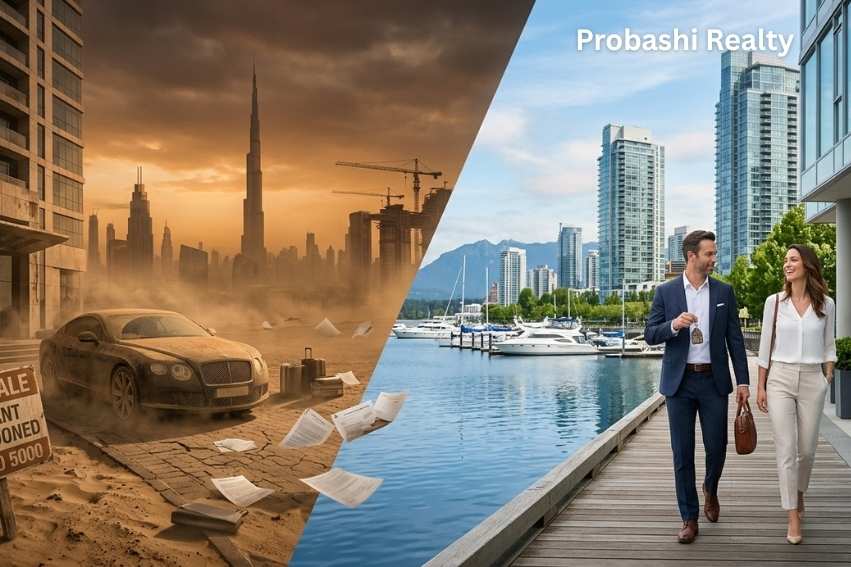
For more than two decades, Dubai has stood as one of the most attractive real estate markets in the world. Known for its luxury skyline, tax-friendly policies, and investor-focused initiatives, the city built a powerful image—one of opportunity, security, and rapid growth. From waterfront villas to high-rise apartments, Dubai became a symbol of modern wealth and global ambition.
However, recent developments have forced investors to rethink that narrative.
The Turning Point: Confidence Under Pressure
Real estate markets are not driven by buildings alone—they are driven by confidence. Dubai’s biggest strength was always its perception as a safe and stable hub in a complex region. But recent security concerns have disrupted that perception.
When uncertainty enters the market, the first reaction is caution. Investors begin to reassess risks, buyers delay decisions, and capital starts to shift. This is exactly what is happening now.
High-net-worth individuals, who once rushed to invest in premium locations, are now prioritizing safety and long-term stability. As a result, demand in luxury segments has slowed, and the market is experiencing a noticeable shift in momentum.
Luxury Market Slowdown and Capital Flight
Areas like Palm Jumeirah and Dubai Marina, once considered prime investment zones, are seeing reduced activity. Some investors are exiting, while others are holding back on new purchases.
This movement is not just about property—it reflects a broader trend of capital flight. When investors lose confidence in a market’s stability, they don’t wait. They move their funds to safer environments.
At the same time, incentives like long-term residency tied to property ownership are losing their appeal. When people begin to leave a region, the value of such benefits declines rapidly.
Oversupply: A Growing Concern
Dubai’s development strategy has always been ambitious. The city consistently launched large-scale residential and hospitality projects, often building ahead of demand.
In times of growth, this strategy worked well. But in uncertain conditions, it creates pressure.
With thousands of new units entering the market, the gap between supply and demand is widening. This has led to:
- Declining occupancy rates
- Slower property sales
- Increased competition among developers
- Pressure on rental yields
Some mega-projects are now facing delays, and in certain cases, investors are questioning whether all planned developments will reach completion.
The Hidden Cost of Infrastructure
One of the most overlooked aspects of Dubai’s real estate market is the cost of maintaining its environment.
Unlike naturally developed cities, Dubai relies heavily on artificial infrastructure. Cooling systems must run year-round due to extreme temperatures. Large-scale developments, including waterfront and reclaimed land projects, require continuous maintenance.
These costs do not disappear when properties are vacant. Even during slow market periods, developers and authorities must invest heavily to maintain livability and appeal.
This creates financial pressure, especially when revenues from tourism and property transactions decline.
Shifting Global Investment Trends
As uncertainty grows, global investors are not standing still. Capital is quickly moving toward markets that offer stronger stability and long-term security.
- Riyadh is emerging as a key regional competitor, supported by economic reforms and large-scale development plans
- Singapore continues to attract investors with its strong governance, financial security, and global reputation
- Established markets such as Canada, Australia, and United Kingdom are seeing renewed interest due to their political stability and transparent legal systems
While these markets may offer lower short-term returns compared to Dubai’s peak years, they provide something increasingly valuable—certainty.
Changing Definition of “Prime Location”
The current situation is redefining what investors consider a “prime” real estate market.
In the past, factors like luxury, architecture, and high rental yields were enough to attract buyers. Today, investors are looking deeper. They are asking:
- Is the region politically stable?
- Is the economy diversified?
- How resilient is the market during global shocks?
- Are infrastructure and maintenance costs sustainable?
This shift in mindset is transforming global investment strategies.
Key Lessons for Real Estate Investors
Dubai’s current challenges offer important lessons for investors worldwide:
1. Diversification is essential
Relying on a single market—no matter how attractive—can be risky. A balanced portfolio across multiple regions helps reduce exposure to sudden changes.
2. High returns often come with hidden risks
Markets offering very high yields may also carry underlying vulnerabilities. It is important to evaluate both opportunity and risk together.
3. Stability matters more than ever
Long-term success in real estate depends on security, strong governance, and economic resilience—not just short-term growth.
4. Look beyond surface appeal
Luxury developments and modern infrastructure can attract attention, but true value lies in sustainable demand and long-term viability.
The Road Ahead
Dubai is not disappearing as a global real estate hub. It still has strong fundamentals, world-class infrastructure, and a strategic location. However, it is clearly entering a new phase—one that requires adjustment, resilience, and renewed investor confidence.
For global investors, this is a moment of reflection.
Markets rise and fall, but the principles of smart investing remain constant. Security, diversification, and long-term thinking will always define successful real estate strategies.
Join The Discussion