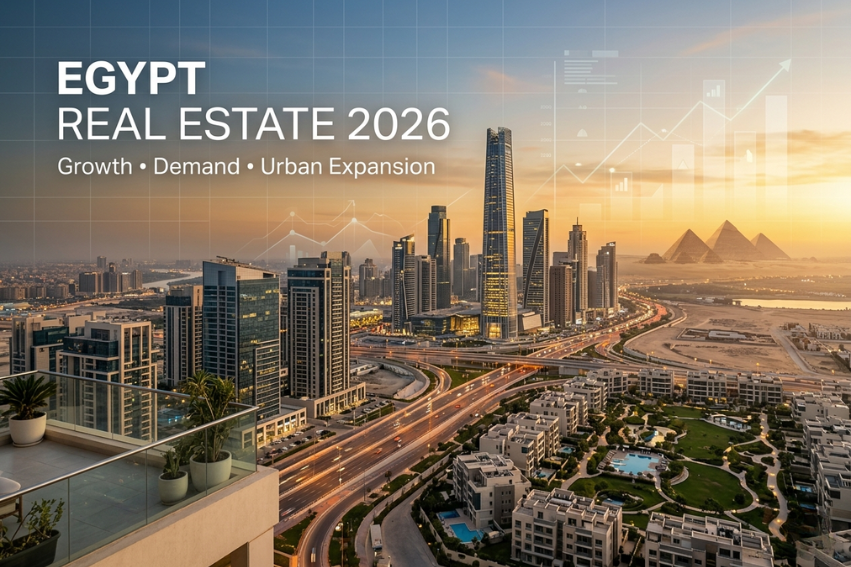
In 2026, Egypt’s property market is not driven by speculation or rapid cycles — instead, it is shaped by structural demand, inflation dynamics, and large-scale urban expansion.
With a population exceeding 110 million and growing steadily, housing demand remains fundamentally strong. At the same time, government-led mega projects and private sector development continue to reshape the country’s urban landscape.
The result is a market that is high-growth, supply-driven, yet increasingly segmented by affordability and income levels.
Market Overview: Growth Anchored in Real Demand
Egypt’s real estate sector in 2026 continues to expand, supported by both demographic pressure and large-scale infrastructure investment. With a population exceeding 110 million and a steadily growing middle class, housing demand is not speculative—it is deeply rooted in real, long-term need.
Unlike many global markets where demand fluctuates with investor sentiment, Egypt’s property sector is primarily driven by end-users. Millions of young Egyptians are entering the housing market each year, creating continuous pressure for new residential supply across different income segments.
At the same time, the government is playing a central role in reshaping the market through ambitious national projects. Developments such as the New Administrative Capital, New Alamein, and the expansion of Greater Cairo are not only increasing housing supply but also redistributing population density away from overcrowded urban centers.
Key Market Characteristics:
- Persistent housing demand driven by population growth
- Strong pipeline of government-backed developments
- Expansion of new urban communities outside traditional city centers
- Increasing participation from Gulf and regional investors
- Real estate used as a hedge against inflation and currency depreciation
Unlike many global markets, Egypt’s real estate activity is largely end-user driven, not purely speculative.
Property Prices in 2026
Property prices in Egypt are rising, but the increase is largely cost-driven rather than demand overheating.
Key Price Trends:
- Annual price increases typically ranging between 10%–25% depending on location and segment
- Construction cost inflation (materials, labor, imported inputs) pushing prices upward
- Currency depreciation impacting developer pricing strategies
- Stronger appreciation in newly developed cities compared to older districts
Property Segment Insights:
- Apartments: Core of the market, especially for middle-income buyers
- Gated compounds: Fastest-growing segment due to security and lifestyle appeal
- Villas: High demand in premium developments and expatriate-driven areas
- Commercial real estate: Growing alongside new business districts
Affordability remains a major constraint, particularly for first-time buyers.
Regional Market Insights
Primary Urban Centers:
- Cairo continues to dominate, accounting for the largest share of transactions and development
- Giza remains important for mid-range and affordable housing
High-Growth Areas:
- New Cairo is a leading hub for premium residential and commercial projects
- 6th of October City offers more affordable alternatives with strong demand
- New Administrative Capital is emerging as a key administrative and investment center
Coastal & Lifestyle Markets:
- North Coast Egypt remains a hotspot for luxury and seasonal properties
- Ain Sokhna continues to grow as a weekend and resort destination
These regions reflect a clear shift toward planned communities and lifestyle-driven development.
Supply Dynamics and Structural Challenges
Egypt has one of the largest construction pipelines in the region, yet supply imbalances persist.
Key Supply Trends:
- Significant increase in new housing units across new cities
- Oversupply emerging in high-end and luxury segments
- Ongoing shortage in affordable and lower-middle-income housing
- Rising construction costs slowing delivery timelines
The market is increasingly dual-layered: oversupply at the top, undersupply at the base.
Interest Rates, Inflation & Buyer Behavior
Macroeconomic conditions are heavily influencing buyer decisions.
Key Observations:
- High interest rates limiting mortgage accessibility
- Most transactions still conducted through developer installment plans
- Buyers prioritizing capital preservation over short-term gains
- Increased demand for flexible payment structures (5–10 year plans)
This has created a market where liquidity exists, but access is selective.
Investment Opportunities in 2026
Egypt remains a compelling market for long-term investors, particularly those focused on emerging urban zones.
Key Investment Segments:
- Residential units in new cities and planned developments
- Administrative and office spaces in business districts
- Coastal properties for short-term rental and tourism
- Mixed-use developments combining residential and commercial use
Investment Drivers:
- Strong demographic fundamentals
- Continuous infrastructure expansion (roads, transport, utilities)
- Government incentives for development
- Competitive entry prices compared to global markets
- Potential upside linked to currency adjustments
Investors are increasingly targeting yield stability and long-term appreciation.
Rental Market Outlook
Egypt’s rental sector is expanding, particularly in urban and newly developed areas.
Key Trends:
- Rising rental demand in cities like Cairo and New Cairo
- Strong occupancy in compounds and gated communities
- Increasing rental yields in strategic locations
- Growth of short-term rentals in coastal regions
Rental income is becoming an important component of total investment return.
Key Challenges
Despite strong fundamentals, the market faces several structural challenges:
- Declining affordability due to rising prices
- High inflation impacting both developers and buyers
- Currency volatility affecting investment decisions
- Mortgage market underdevelopment
- Infrastructure gaps in some newly launched areas
These challenges reinforce a selective and segmented market environment.
Future Outlook
Looking ahead, Egypt’s real estate market is expected to:
- Maintain steady growth supported by population demand
- Continue expansion into new urban communities
- See stronger regulation and market organization
- Shift more focus toward affordable housing solutions
- Attract increased foreign and regional investment
The long-term trajectory remains positive, but increasingly dependent on economic stability and policy direction.
Conclusion
The Egypt property market in 2026 is defined by expansion, inflation-driven pricing, and strategic demand.
For buyers, the market offers diverse opportunities but requires careful financial planning.
For investors, it presents strong fundamentals with long-term upside, particularly in emerging urban centers.
Overall, Egypt stands as one of the region’s most dynamic real estate markets — complex, fast-growing, and full of opportunity for well-informed participants.