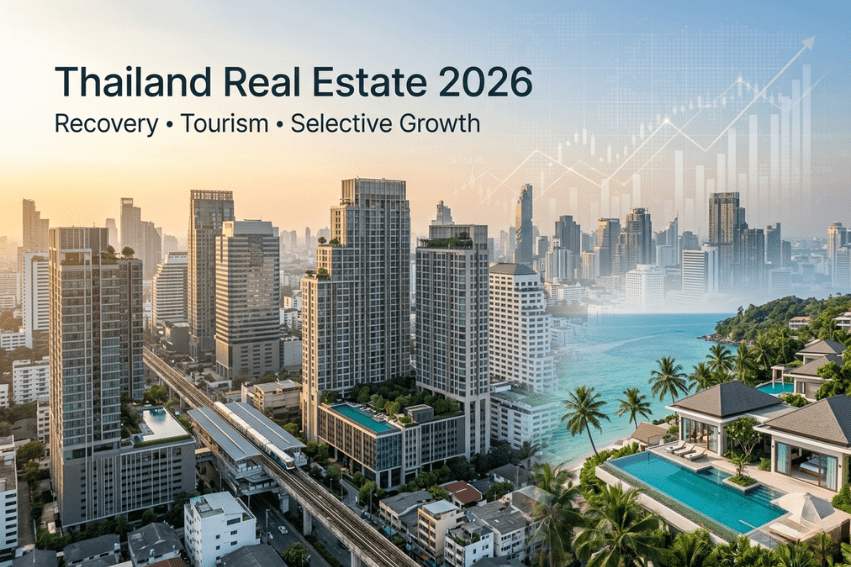
As Thailand enters 2026, its real estate market is moving through a phase of selective recovery shaped by global pressures, tourism dynamics, and foreign investment trends. Unlike high-growth emerging markets, Thailand’s property sector is stabilizing with cautious optimism rather than rapid expansion.
While economic challenges and global uncertainty continue to influence buyer behavior, Thailand remains one of Southeast Asia’s most attractive destinations for lifestyle property and international real estate investment.
In this article, we explore key trends, pricing patterns, and emerging opportunities across Thailand.
Market Overview: Recovery Driven by Tourism & Foreign Demand
Thailand’s real estate sector in 2026 is experiencing a gradual recovery, supported by tourism, infrastructure development, and steady foreign interest.
However, the growth is more selective and cautious, influenced by global economic pressures and domestic policy shifts.
Key characteristics include:
- Recovery in tourism-driven property markets
- Strong demand from foreign buyers (especially in condos)
- Growth in industrial and logistics real estate
- Government reforms aimed at boosting economic activity
- Slower overall economic growth (around 1.5%)
Thailand’s economy is expanding at a moderate pace, with softer exports and tourism recovery affecting overall momentum.
At the same time, the government is planning reforms to stimulate growth, reduce business costs, and attract investment—factors that will directly impact the property sector.
Unlike purely domestic markets, Thailand’s real estate demand is strongly tied to international buyers and tourism flows, especially in cities like Bangkok and resort destinations.
Property Prices in 2026
Property prices in Thailand are showing moderate and location-based growth.
Key Price Insights
- Gradual price increases in prime urban areas
- Stable growth in condominium segment (around 2–4%)
- Stronger performance in luxury and high-quality developments
- Slower growth in suburban or oversupplied areas
Property Type Trends
- Condominiums: Dominant segment, especially among foreign buyers
- Villas & Resorts: High demand in tourist areas like Phuket
- Luxury properties: Stable due to limited supply in prime locations
Bangkok’s market is seeing a “flight to quality,” where buyers prefer premium developments over cheaper alternatives.
Regional Market Insights
Thailand’s property trends vary significantly between urban centers and tourist destinations.
Major Urban Markets
- Bangkok remains the core real estate hub
- Demand increasing for high-quality office and residential spaces
- Rental demand improving with business activity
Resort & Lifestyle Markets
- Phuket and Pattaya driven by foreign buyers and tourism
- Strong demand for holiday homes and short-term rental properties
- Coastal developments attracting international investors
Tourism continues to play a critical role, though recovery has been slower than expected in some periods.
Supply and Demand Dynamics
The balance between supply and demand is improving but uneven across sectors.
Supply Trends
- Increase in condominium launches after previous slowdown
- Developers focusing on high-demand, prime locations
- Growth in industrial and logistics real estate
Demand Trends
- Strong foreign buyer activity
- Rising interest in rental-focused properties
- Demand for smart buildings and modern amenities
Industrial properties and data centers are emerging as strong investment sectors due to digital and logistics growth.
Interest Rates and Buyer Behavior
Economic conditions are shaping how buyers approach the market.
Key Observations
- Buyers are more cautious due to global uncertainty
- Financing conditions remain relatively tight
- Increased focus on long-term investment rather than speculation
Global factors like rising energy prices and economic uncertainty are influencing purchasing decisions and affordability.
Investment Opportunities in 2026
Thailand remains a key real estate investment destination in Southeast Asia.
Top Investment Segments
- Condominiums in Bangkok
- Vacation properties in Phuket and Pattaya
- Industrial and logistics facilities
- Data centers and tech-related infrastructure
Why Investors Are Interested
- Strong tourism sector (long-term potential)
- Growing regional investment interest
- Competitive pricing compared to global markets
- Strategic location in Southeast Asia
Investor sentiment across Asia-Pacific real estate is rising, with Thailand benefiting from renewed regional interest.
Rental Market Outlook
The rental market in Thailand is gradually strengthening.
Key Trends
- Increasing demand in Bangkok’s urban areas
- Growth in short-term rentals in tourist destinations
- Rising rental yields in prime locations
- Recovery linked closely to tourism performance
Short-term rental markets remain highly dependent on international travel trends.
Challenges in the Market
Despite recovery, several challenges remain:
- Slower economic growth and external pressures
- Currency fluctuations and energy costs
- Political and policy uncertainties
- Oversupply in some condominium segments
Recent energy concerns and global tensions are also impacting costs and market sentiment.
Future Outlook
Looking ahead, Thailand’s real estate market is expected to:
- Continue gradual and selective growth
- Strengthen in tourism-driven regions
- Attract more foreign investment
- Expand in industrial and digital infrastructure sectors
The market is shifting toward quality, sustainability, and long-term value rather than rapid expansion.
Conclusion
The Thailand real estate market in 2026 is defined by recovery, selectivity, and international influence.
For buyers, it offers diverse opportunities—from urban condos to coastal lifestyle properties.
For investors, it presents strong potential in tourism-driven and industrial sectors.
Overall, 2026 is a year of cautious growth and strategic investment in one of Southeast Asia’s most dynamic property markets.